Laser Eye Surgery in Switzerland: Costs and Insurer Benefit
Laser eye surgery is only covered in basic insurance in exceptional cases. Compando shows methods, conditions and when a supplementary insurance for laser eye surgery is sensible.
1. What is laser eye surgery and does the insurer pay?
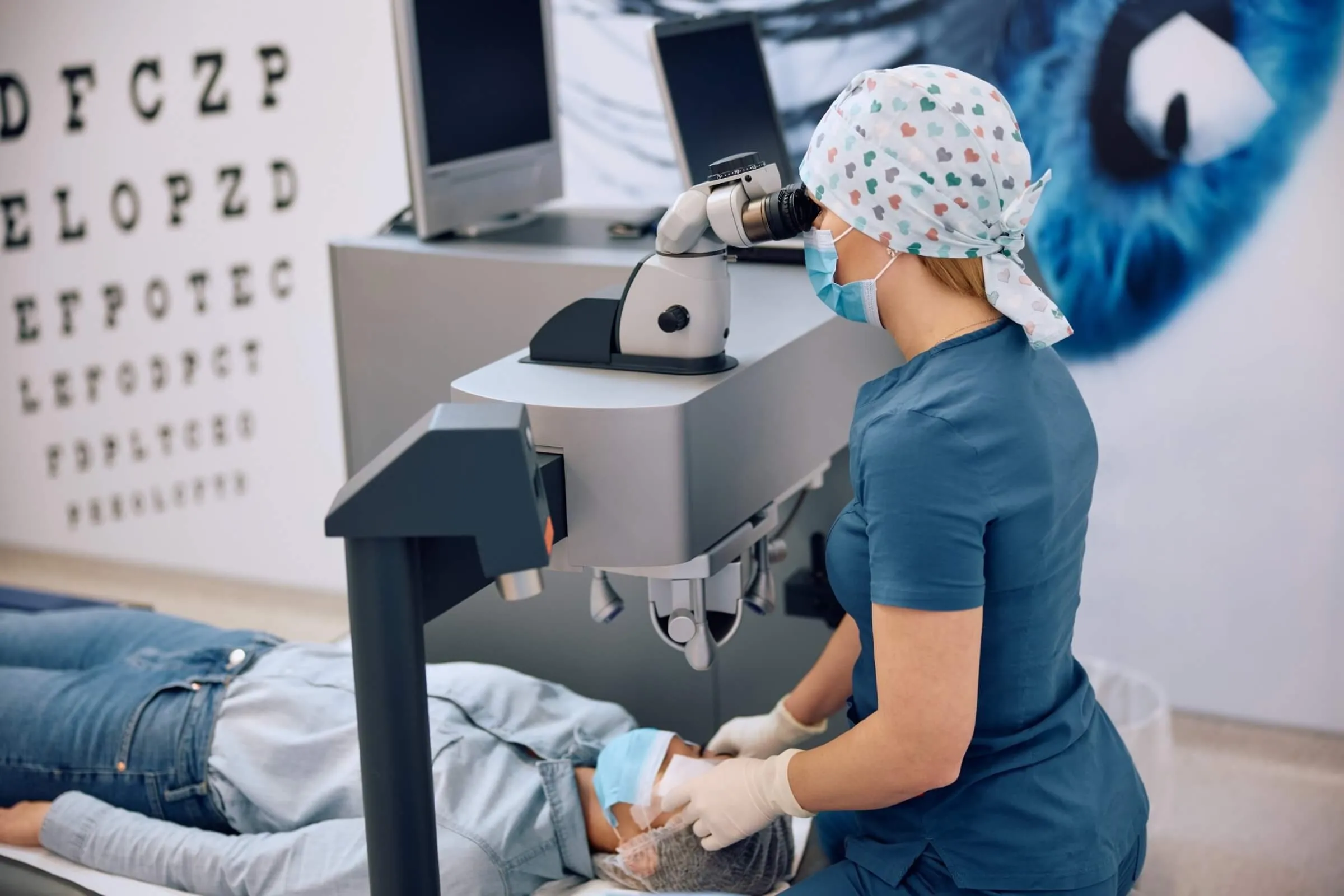
Laser eye surgery (refractive surgery) is the surgical correction of visual defects such as nearsightedness, farsightedness or astigmatism. The laser changes the cornea so that the light again correctly hits the retina. After the intervention, glasses and contact lenses can be set aside in most cases.
Laser eye surgery is not standard covered in basic insurance. Interventions for pure vision correction do not count as medically necessary. Exceptions are regulated in Annex 1 of the Health Care Benefits Ordinance (KLV).
When does basic insurance pay
- Anisometropia over 3 dioptres: if contact lenses are not medically possible, with prior cost commitment
- Cataract: standard monofocal lens covered, premium lenses via supplementary insurance
- Severe eye diseases: if glasses do not allow sufficient correction
For pure vision correction without glasses, an outpatient supplementary insurance is needed. It covers depending on the tariff a fixed or percentage contribution to the laser intervention.
2. Which methods exist for laser eye surgery?
Four methods are widespread in Switzerland. Which is suitable is clarified by an ophthalmological preliminary examination at the specialist for ophthalmology FMH.
- LASIK: The corneal flap is lifted and the laser reshapes the cornea. Suitable for near- and farsightedness up to approx. ±8 dioptres.
- Femto-LASIK: LASIK with femtosecond laser, more precise than the classical method. Today the most frequent variant in Switzerland.
- PRK / LASEK: Surface treatment without corneal flap. Suitable with thin cornea or for athletically active persons.
- SMILE: Minimally invasive, newer procedure without flap. Used above all for nearsightedness.
Assessed are corneal thickness, dioptre course, tear film and possible eye diseases. Not every method suits every visual defect.
Important
The ophthalmological preliminary examination is mandatory and decides on the suitable method. It costs depending on the clinic CHF 100 to 300 and is usually covered neither by basic insurance nor by supplementary insurance. Request a written cost estimate with warranty benefits for any subsequent corrections.
3. Which conditions and risks exist for laser eye surgery?
Not everyone comes into question for laser eye surgery. The preliminary examination at the ophthalmologist decides on medical suitability.
Medical conditions:
- Stable visual acuity: At least 1 year no change of dioptres
- Minimum age 18 years: Below, the eyes are still in development
- Sufficient corneal thickness: Cornea too thin excludes LASIK, PRK remains an alternative
- No active eye diseases: No infections, inflammations or keratoconus
- Not pregnant or breastfeeding: Hormonal changes influence visual acuity temporarily
Possible risks (rare but known):
- Under- or overcorrection: The visual acuity is not fully corrected; a subsequent correction can become necessary
- Dry eyes: Most frequent side effect, usually temporary
- Halos and glare: Above all at night, usually improves after 3 to 6 months
- Flap problems with LASIK: Rare, but possible with strong trauma to the eye
Regular control appointments and consistent eye drop application in the first weeks reduce the risks. With already diagnosed eye diseases, the insurer can set a policy restriction or reject the application for supplementary insurance. A health questionnaire is mandatory at application.
4. What does laser eye surgery cost and what does the supplementary insurance pay?
The costs vary strongly by method and provider. Per intervention (both eyes), the prices lie between CHF 2'000 and 5'500.
Reference values 2026 (both eyes):
Method | Costs |
|---|---|
PRK / LASEK | CHF 2'000–4'000 |
LASIK / Femto-LASIK | CHF 2'500–4'500 |
SMILE | CHF 3'500–5'500 |
The price usually includes preliminary examination, intervention, aftercare appointments and control examinations up to 6 months after the intervention. Extra costs arise with subsequent corrections (5 to 10 percent of cases) and eye drops for aftercare (CHF 50 to 150).
An outpatient supplementary insurance for laser eye surgery covers:
- Fixed contribution: one-off amount of CHF 300 to 1'500, independent of the intervention price
- Percentage share: 50 to 100 % of the intervention costs up to a maximum amount of CHF 2'000 to 4'500
- Combination packages: glasses and laser contribution in one tariff, frequently cumulable over several years
- Waiting period: depending on provider 3 to 12 months, individual tariffs also pay immediately
- Conditions: some providers tie the contribution to minimum dioptres, minimum age or an ophthalmological prescription
Which supplementary insurance suits the vision correction need depends on the chosen method and the eye findings. Prerequisite for the benefit is the conclusion before concrete treatment need and observance of any waiting periods. Binding are the General Insurance Conditions (AVB) of the chosen product.
Good to know
Some supplementary insurance counts the annual glasses contribution towards the laser intervention. This way, amounts accumulated over several years can be used together with the laser contribution and cover a larger part of the intervention costs.
Check supplementary insurance contribution
The contributions of supplementary insurance for laser eye surgery differ depending on provider and tariff. Check the General Insurance Conditions. Tip: In the Compando comparison, you can directly compare laser contribution and waiting periods.
5. When is supplementary insurance for laser eye surgery sensible?
Anyone who wears glasses or contact lenses daily can replace the running visual aid costs with laser eye surgery. The intervention is one-off, glasses and contact lenses cost annually. Over 10 years, the visual aid costs often add up to comparable amounts.
Example calculation: A 32-year-old person with −4.5 dioptres decides for Femto-LASIK (CHF 3'200 for both eyes). The outpatient supplementary insurance participates once with CHF 1'000. Remaining own costs: CHF 2'200. In comparison, a new pair of glasses every 3 years over 10 years costs around CHF 1'500 to 4'000. With daily contact lens use, the costs add up to CHF 3'500 to 6'000 over 10 years.
A supplementary insurance for laser eye surgery is particularly sensible with:
- Daily contact lens use: The running costs often exceed the one-off costs of the intervention already after a few years
- Sports activity or frequent travel: Practical advantages in everyday life without glasses or contact lenses
- Young age with stable visual acuity: The intervention pays off over decades
A supplementary insurance for laser eye surgery is less sensible with:
- Rare glasses use: The financial benefit is small; the intervention serves above all comfort
- Age over 45 years: Age-related reading visual weakness (presbyopia) occurs independently of the intervention and usually still requires reading glasses
Anyone who wants to keep the visual aid and only reduce the running costs best checks a supplementary insurance for glasses. Which supplementary insurance is sensible depends on personal need and visual aid behaviour.
Adapt the supplementary insurance to your needs
Different persons have different needs for laser eye surgery. Athletes, contact lens wearers and frequent glasses changers have different priorities. Because premiums and benefits differ, a comparison pays off.