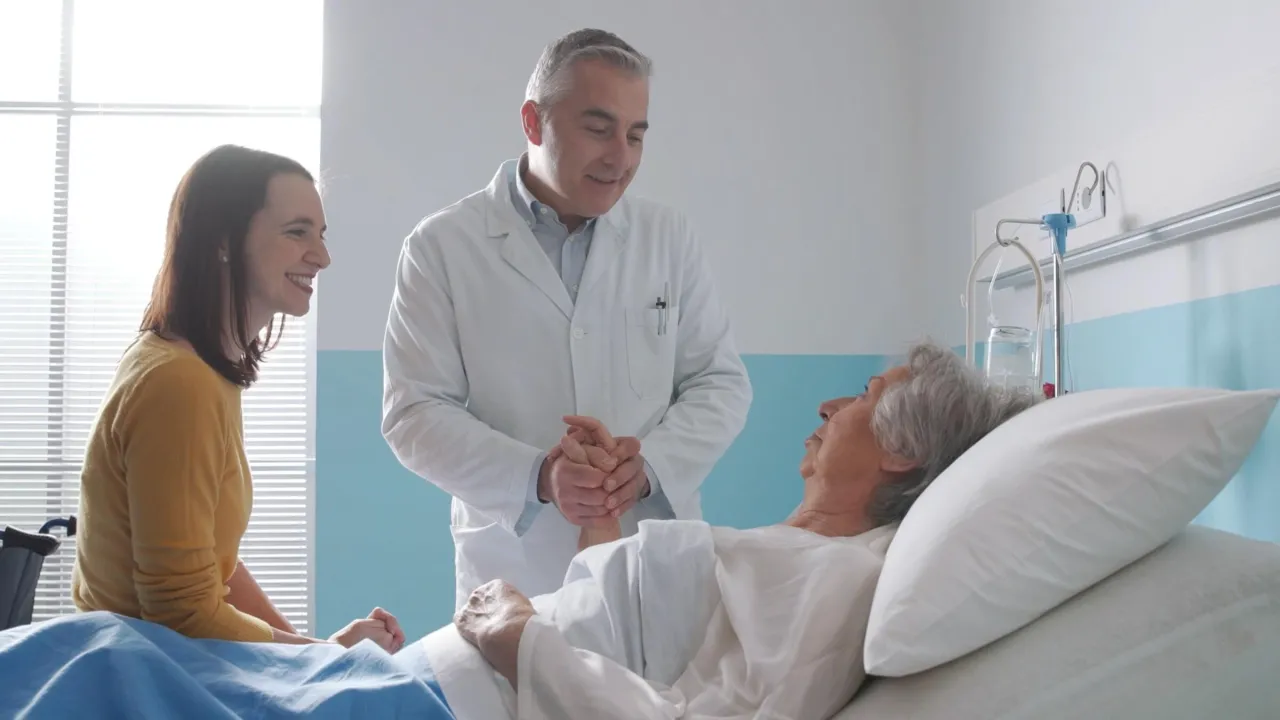
Hospital Insurance Private: What Does It Mean?
Insurers offer various supplementary insurance products. The hospital supplementary insurance private is the most comprehensive variant. Compando explains what you should know about the private hospital insurance.


1. What does privately insured mean?
Privately insured means: you have a hospital supplementary insurance that covers the single room and the chief physician treatment during an inpatient hospital stay. It counts among the highest level of supplementary insurance in Switzerland.
The term comes from room choice: privately insured persons receive a single room with maximum privacy. So "private", the highest of the three levels above semi-private (twin room) and the general ward (multi-bed room). Compared to the basic insurance of Swiss insurers, the scope of benefits additionally comprises maximum comfort, free choice of doctor with chief physician treatment and hospital choice Switzerland-wide including private clinics.
At conclusion, the insurer examines the health condition. The health questionnaire decides on admission and conditions. With existing illnesses, policy restrictions or rejection are possible.
2. Which benefits does the private hospital insurance cover?
The exact benefits differ between insurer and tariff. Privately insured persons usually have entitlement to:
- Single room: You receive a single room with maximum privacy.
- Free choice of doctor with chief physician: Treatment by chief physician, senior physicians or visiting doctors.
- Switzerland-wide hospital choice including private clinics: Prerequisite is a tariff contract between hospital and insurer.
- Medical second opinion: Entitlement to second assessment before larger interventions.
- Co-determination right for elective interventions: You plan operation dates together.
- Extended hotel services: À la carte meals, transfer and rooming-in depending on tariff.
- Abroad coverage: Contributions to emergency treatments abroad, with tariff limit.
Good to know: Two-class medicine is forbidden in Swiss hospitals. With medical necessity, senior physicians also treat patients of the general ward. The class differences concern comfort and freedom of choice, not medical quality.
3. Advantages and disadvantages of the private hospital insurance
Whether the private hospital insurance pays off depends on personal needs. The following points help with the decision:
Advantages
- Single room with maximum privacy
- Free choice of doctor with treatment by chief physician
- Switzerland-wide hospital choice including private clinics
- Entitlement to medical second opinion
- Co-determination right for operation dates
- Extended comfort and service benefits
- Abroad coverage for emergency treatments
Disadvantages
- Highest monthly premium of all three hospital models
- Obligation for health questionnaire before conclusion, admission not guaranteed
- Policy restrictions possible with existing illnesses
- Premium rises strongly with age (three- to fourfold between 30 and 65 usual)
- Single room without guarantee at full occupancy
- Possible waiting periods for maternity benefits (often 270 to 365 days)
- Hospital choice limited to hospital list of the insurer
The hospital supplementary insurance exists in three models: private with single room and chief physician treatment, semi-private with twin room and senior physician treatment as well as Flex with freedom of choice during hospital stay and own share at upgrade.
Compare private hospital insurance
Which private hospital insurance fits? Comfort benefits and abroad coverage differ between providers. A comparison shows the differences in benefits and premiums.
4. What does a private hospital insurance cost?
The premium depends on the following factors:
- Age at conclusion
- Canton of residence
- Insurer and tariff
- Gender (in some tariffs)
- Chosen deductible in basic insurance
Reference values 2026 by age:
Age | Premium per month (approx.) |
|---|---|
Child (0 to 18 years) | CHF 20 to 40 |
Adult (30 years) | CHF 80 to 140 |
Adult (45 years) | CHF 150 to 250 |
Adult (60+ years) | CHF 300 to 500 |
Besides the premium, providers also differ in hospital list, private clinics selection and abroad coverage. The premiums rise significantly with age, often by three- to fourfold between age 30 and 65.
Hospital supplementary insurance by own needs
Needs around hospital, comfort and choice of doctor are individual. Because premiums and benefits between providers can differ by several hundred francs per year, a comparison with personal offer pays off.